Introduction: When Effort Increases but Results Slow Down
One of the most frustrating experiences in any health journey is doing “everything right” and still seeing no progress. Calories are reduced, workouts are consistent, carbohydrates are controlled, and yet weight loss slows or completely stalls. Energy drops. Motivation fades. Hunger increases. The body feels resistant.
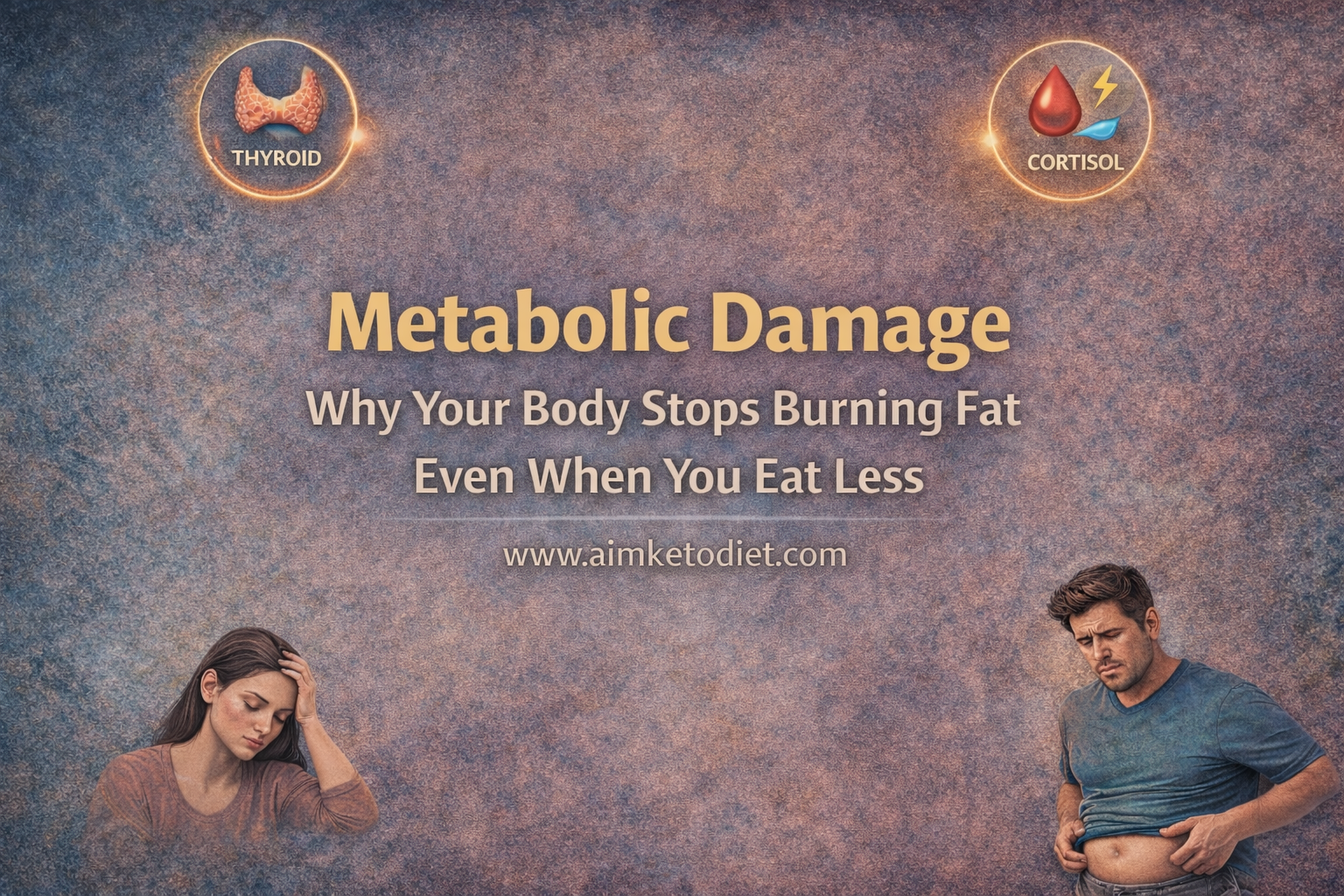
This condition is often described as metabolic damage — a term used to explain the state where the body adapts to prolonged dieting or stress by slowing down its energy expenditure.
While the word “damage” can sound extreme, what is really happening is metabolic adaptation. The body is protecting itself.
On Aimketodiet.com, we focus on understanding why the body behaves the way it does instead of blaming willpower or discipline. When fat loss stops despite effort, it is rarely laziness. It is usually biology.
To move forward, we must understand how metabolism works and why it slows.
What Metabolism Actually Means
Metabolism is not just how fast you burn calories. It refers to the total number of chemical processes that keep you alive. These include breathing, circulating blood, maintaining body temperature, repairing tissues, and producing energy at the cellular level.
Your metabolic rate consists of:
Basal metabolic rate (energy used at rest)
Energy used for movement
Energy used to digest food
When calorie intake drops significantly for long periods, the body adjusts by lowering energy expenditure. It becomes more efficient — burning fewer calories for the same tasks.
This adaptation is not failure. It is survival.
The Body’s Survival Mechanism During Calorie Restriction
When you reduce food intake drastically, the brain perceives a potential threat. From an evolutionary perspective, prolonged calorie restriction signals possible famine.
In response, the body:
Lowers thyroid hormone conversion
Reduces non-essential movement
Increases hunger hormones
Decreases leptin (satiety hormone)
Raises cortisol levels
This slows fat loss and conserves energy.
What feels like “metabolic damage” is often the body attempting to preserve survival.
The Thyroid and Metabolic Slowdown
The thyroid gland regulates metabolic speed. During prolonged dieting, the body may reduce conversion of T4 (inactive thyroid hormone) to T3 (active thyroid hormone).
Lower T3 levels mean:
Slower calorie burning
Increased fatigue
Cold sensitivity
Decreased motivation
Even slight reductions in thyroid activity can significantly influence fat loss.
This is why some people experience weight plateaus after extended dieting.
Leptin: The Hidden Metabolic Signal
Leptin communicates fullness and energy sufficiency to the brain. When body fat decreases or calorie intake drops for extended periods, leptin levels fall.
Low leptin signals the brain to:
Increase hunger
Reduce metabolic rate
Conserve energy
The body does not differentiate between intentional dieting and starvation. It reacts biologically.
Cortisol and Chronic Diet Stress
Prolonged calorie restriction combined with intense exercise increases cortisol levels. Elevated cortisol encourages fat storage, particularly around the abdomen.
High cortisol also interferes with sleep and blood sugar regulation, further complicating fat loss efforts.
When dieting becomes stressful rather than sustainable, hormonal shifts may stall progress.
Why Eating Less Eventually Stops Working
In the early stages of calorie reduction, weight loss occurs because energy intake is lower than expenditure. Over time, the body compensates by lowering expenditure to match intake.
This means:
You burn fewer calories at rest
You unconsciously move less
Hormonal signals shift toward conservation
The calorie deficit shrinks without you realizing it.
This explains why someone eating 1,500 calories may lose weight initially but later plateau at the same intake.
The Starvation Mode Myth Explained Clearly
“Starvation mode” is often exaggerated online. The body does not suddenly stop burning calories completely. However, metabolic adaptation is real.
The slowdown is gradual and proportional. It does not defy physics, but it does reduce efficiency.
Understanding this distinction prevents unnecessary fear while still respecting biological reality.
Metabolic Flexibility: The Key to Long-Term Fat Loss
Metabolic flexibility refers to the body’s ability to switch between burning carbohydrates and fats efficiently.
When someone diets repeatedly without proper recovery, metabolic flexibility declines. The body becomes rigid in its energy usage patterns.
A properly structured ketogenic approach can improve metabolic flexibility by teaching the body to utilize fat as a primary fuel source. However, if done under extreme stress or severe restriction, it may contribute to adaptation rather than healing.
The goal is balance — not perpetual restriction.
Signs Your Metabolism May Be Adapting
Persistent fatigue, cold sensitivity, hair thinning, irritability, sleep disturbances, and weight plateaus despite low calorie intake are common indicators.
These symptoms often overlap with hormonal imbalance, which is why the previous topic naturally connects to this one.
Metabolism and hormones operate together.
How to Support and Restore Metabolic Function
Restoration does not require overeating but may require strategic adjustments.
Increasing protein intake supports muscle mass and metabolic rate. Prioritizing sleep lowers cortisol. Managing stress protects thyroid conversion.
Periodic calorie cycling or strategic refeeds can help maintain leptin sensitivity. Strength training preserves lean muscle tissue, which supports resting metabolic rate.
Improving gut health reduces inflammation, allowing hormones to communicate more efficiently.
At Aimketodiet.com, we emphasize sustainable strategies rather than extreme restriction. Metabolic health improves when stress decreases and nutritional adequacy increases.
Long-Term Fat Loss Is a Hormonal Process, Not Just a Calorie Equation
Calories matter, but hormones decide how those calories are used.
When insulin is stable, cortisol is controlled, thyroid hormones are active, and leptin signals are balanced, fat loss becomes more sustainable.
When these systems are stressed, the body protects itself.
Understanding this removes guilt and replaces it with strategy.
Conclusion: Stop Fighting Your Metabolism and Start Supporting It
If weight loss has stalled despite effort, the solution is not always “eat less.” Often, it is the opposite — support the systems that regulate energy.
Metabolic adaptation is not a permanent condition. It is a protective response. When stress decreases, sleep improves, nutrient intake is optimized, and hormonal balance is restored, metabolism becomes responsive again.
On Aimketodiet.com, the mission is to explain the science behind these experiences so that frustration turns into understanding. Fat loss is not about punishing the body. It is about working with biology rather than against it.
When you support your metabolism properly, progress becomes sustainable instead of exhausting.